Shaheda shares how when she experienced a second trimester loss when she lost her son Ibraheem at just over 18 weeks it was the most devastating thing that has ever happened to her. She shares how family didn’t know what to say, how miscarriage is a big taboo in South Asian culture, and how some people expected her to move on quickly. A few months after losing Ibraheem Shaheda joined Sands South Asian group, which was the first time she could openly talk about how difficult it was to have a miscarriage in an Asian family. It was the start of a wonderful relationship with Sands. Since then, Shaheda has supported Sands using her talent and skills in pottery to make precious Sands remembrance diyas to help other bereaved families remember their babies.
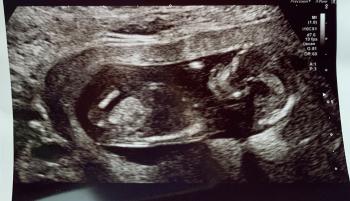
Please be aware Shaheda has chosen to share a scan of baby Ibraheem.
“Ibraheem was born on the 18th January 2025 just over 18 weeks. When he was born, I was already in hospital because my waters had broken. Losing him was the most devastating thing that has ever happened to me.
Ibraheem was our second loss as in 2024 I lost a baby at 11 weeks. I was devastated, and it took some time, but I moved on and we got pregnant again. When Ibraheem passed away it hit me like a brick. It was almost disbelief as I had hope when I was getting further and further on in my pregnancy. It felt even worse because I’d turned 40 years old and I felt like it was my last chance to be a mum again. I have a three-and-a-half-year-old toddler and he's always playing on his own and I really wanted him to grow up with somebody.
When this pregnancy happened, we were overjoyed, and I did everything possible to keep safe. I wasn't even taking throat lozenges when I had a cough because I thought they might have ingredients that might affect the baby. I was so careful on every level and in the end, it didn't matter because something happened that was out of my control.
Coming to terms with the loss of Ibraheem was so difficult as he was much loved and longed for. I was in bed for days. I wasn't taking my medication, and I was just so desperate for that baby that when it didn’t come about, I felt like every waking moment was unbearable. It was devastating to a point where there was just no hope for life.
Nobody in my family has ever had a miscarriage or suffered baby loss, so when it happened, they almost didn't know what to do or say.
They were saying things like it's God's will, it wasn't meant to be and it’s nature taking its course – everything you just don't want to hear. My mum and sisters were there for me, my mum tried so hard to make me feel better, but she didn't know what to say or do. She was almost trying to get my mind off it instead of allowing me to digest what had happened. When I was lying in bed she'd open the curtain, bring me food and just feed me, we didn’t say anything and we would just cry together. I think what I really needed was for someone to say “cry as long as you want, and if you want to lay in bed, it's fine too, I’ll be right here next to you”, just so I wouldn’t feel like I was doing anything wrong or going mad. There's no exact way to grieve so whatever happens in those early days, you just need to let it happen.
I also wish people would have let me have the chance to say my baby’s name – that’s the one thing I wish people would have let me have.
My son was born too soon, so there was no obligation to name him. No one asked if I wanted to name him and that was the one thing I desperately wanted to do. When I gave birth to him, he had beautiful eyes, a little nose, he had a mouth and ears. I could see his features and that he looked like my toddler, Noah, they had the same shaped face. It was strikingly similar, even in that early gestation, but I had to quietly name him in my heart, not formally. I named him Ibraheem after one of the Prophets in Islam who takes care of children who leave the world early until they are reunited with their parents. Naming Ibraheem brought me great peace in those early days of grief.
Miscarriage is a big taboo in South Asian culture.
In our culture, we celebrate happy events, like the birth of a baby, weddings, graduations. Anything that's positive we love to celebrate but anything negative we tend to keep quiet. Although you're allowed to grieve, nobody wants to talk about it or to ask how you’re coping after the first few weeks. Losing Ibraheem was so painful, it took me a long time to start living again, but there were people around me who didn't even acknowledge his death and expected me to move on quickly.
That was when I reached out to Sands. I went on their website and found the Sands South Asian Zoom meetings.
Three months after my loss I joined my first online meeting and that was the beginning of a wonderful relationship with Madhuri, Sands Outreach Coordinator for South Asian Communities and Sands more widely. Madhuri gave me so much time to speak about Ibraheem. She asked about his name, about my family and if I was getting any support outside of Sands. Madhuri made me feel very seen and heard, and it felt like a great big hug coming from her through my phone, so I decided I'd attend another meeting.
The Sands South Asian group was the first time I could openly talk about how difficult it was to have a miscarriage in an Asian family when nobody else had suffered it, and if they have, they've never spoken about it.
In the group I didn't feel any pressure to explain anything because everybody knew what I was going through. I remember two other ladies attended for the first time at the same time as me. One was hiding in a bedroom, and the other was about 30 minutes late and was standing in a hallway. I knew what they were going through because in our culture, when you have a family around you, you've got a husband, you've got a toddler, maybe you've got your mother-in-law in the house, there's never a space for you to have a moment to yourself. You often feel guilty just going to your bedroom for 10 minutes to have a little think because you know when you step out, they'll be asking, what were you doing in there? Are you okay? What's going on? And that's what those ladies were going through on that call, but they didn't have to explain any of that. They could just concentrate on speaking about their babies because in our culture it’s really difficult to talk in the house about it. Madhuri knew and understood that too. She said from the get-go, are you in a safe space to talk? If you feel like you need to leave just exit, it's okay, so the entire time you felt safe and you didn't have to explain the unnecessary. That was really precious.
During the second meeting I went to, Madhuri asked what I do for a living and I told her I make pottery, but I hadn't done so since having my toddler.
After my son Noah was born in 2022, being a new mum was all consuming, I just couldn't find the time or energy to make any pottery, but I would always look at my wheel in the corner of the room and miss using it. Then, after losing Ibraheem I was stuck in such a deep grief I didn't feel like I could do anything that brought me joy, including pottery. The pain was so intense that I could physically feel it in my chest, for a long time I didn't want to stop feeling that pain because it made me feel like I was closer to Ibraheem and moving on from that just felt wrong to me.
But over the next few meetings with Sands, Madhuri asked if I could make something called a Diya for her for Sands Garden Day.
One night about 2am my brain was ticking away, and I was thinking too much again. I had a bag of clay, so I turned on my pottery wheel and made three little Diyas. They came out perfect on the first go, almost like my rhythm had come back three and a half years after I last touched clay. And for those 30 minutes on the wheel I realised I felt a little bit like myself again.
When I presented the Diya to Madhuri, she tearfully told me it was beautiful and absolutely perfect. During Sands Garden Day, I was mentioned during a wonderful speech, which brought me to tears because my baby was mentioned and Sands acknowledged how difficult it had been for me to pick up my clay again. I’m so grateful to Sands for giving me the strength to do that and for asking me to help them, which in turn helped me. Spiritually making that first Diya centred me back into who I was. So, after a long pause, I returned to pottery with a new perspective and have not stopped making.
Making pottery has helped my healing journey 1000%.
I searched daily for a way to navigate through my grief, desperately looking for ways to feel better. Pottery has been the most powerful tool in my healing, it has become a therapy on days when I need a distraction to quiet the constant hum, to propel me forward and to give each day a purpose. Every minute spent with my hands in clay reminds me of this art that I love. I’m so grateful to my husband for always giving me the time and space to enjoy pottery, he has always been a cheerleader, spurring me on to keep creating.
Losing a baby is a grief like no other.
You lose a part of your soul when that baby goes away, so it's not something that can be repaired in days, weeks or months. Bereaved parents literally carry that grief every day of their lives and people need to be mindful of that. It's been a year since I lost Ibraheem and people have said I need to move on, but that is not how grief works. We learn to live in a world without our babies, we carry them in our hearts and the pain of losing them every single day.
If you’re not sure how to support a bereaved parent, go on the Sands website. It will help you to understand what that parent is going through and find out what you can do to support them. The very simplest thing you can do is ask how are you doing? Are you missing your baby? Do you want to talk about them? I'm listening. And that's pretty much all a grieving parent ever wants, because we never forget our babies, no matter what gestation, we remember them and wonder what they would be doing today. Asking about our baby means a lot and is the most important thing.
If I'd not met Madhuri and had the support of Sands, I wouldn’t be feeling the way I am now and I wouldn’t be as strong as I am now.
Madhuri really held my hand and my heart in those horrible early months where I was so lost I didn’t even feel like making a cup of tea because I was so low. I'm really thankful to her and Sands for gently giving me the confidence to find myself again, for helping me to navigate through grief and allow myself to feel joy again."