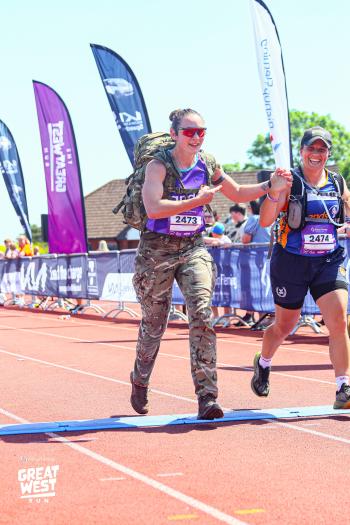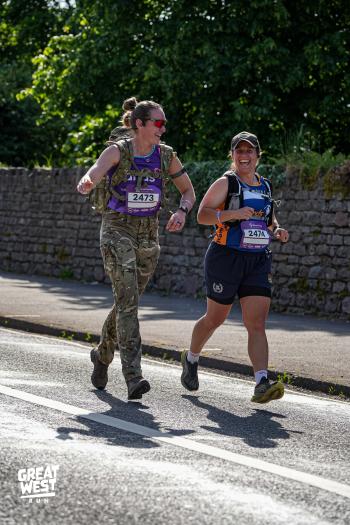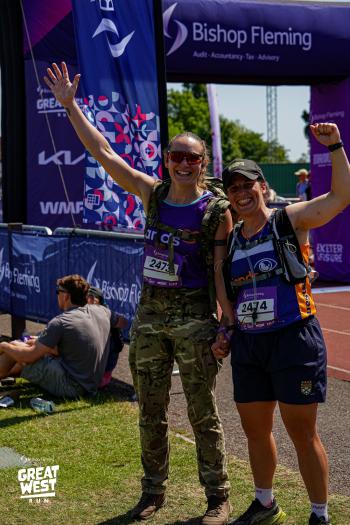
A year and a half ago Lucy and her wife Lydia started their IVF journey. Since then they have experienced three miscarriages. Lucy shares how talking about their multiple miscarriages has massively helped them to process how they feel and opened up conversations with others. She also shares why she and Lydia decided to take on the Great West Run, a half marathon in Exeter, for Sands, with Lucy wearing a weighted 20kg backpack and her full Army gear during the challenge.
“About a year and a half ago my wife Lydia and I started our IVF journey. We were very naïve and thought the hardest thing would be getting pregnant, when for us, actually the hardest part has been for a baby to stay.
We found out about our first miscarriage during an eight week private scan. We turned up thinking this is going to be brilliant, we're going to be able to start telling people, but it ended up being the worst moment for us. We thought it could just be bad luck although we grieved the idea of our baby’s future and the hope we had. As our miscarriage was so early on we almost felt like we shouldn't be as upset as we were, which is insane, because it doesn't matter how early on a loss is, you feel what you feel.
We tried IVF again a couple of months later but that ended in a natural miscarriage at about five or six weeks when Lydia started bleeding quite heavily. Again, that was really hard, so we took a few months out and then started our third round of IVF in the early autumn.
It wasn't until our third and most recent miscarriage in October 2025, that I was pointed in the direction of getting help from charities and reading about loss.
Up until then I had muddled through and tried to keep busy. My wife was struggling so I felt like I had to be the strong one, but doing that took a battering on my mental health as I was so exhausted trying to carry on the façade that everything was okay.
I work in the Army and eventually I told them I was struggling.
The Army welfare team told me miscarriage was quite common, and that's when Lydia and I started researching. Before that we didn't realise how common miscarriages are. No one really speaks about it, and it seemed like such a taboo subject. There’s no rhyme or reason for our three miscarriages. We're both fit and healthy individuals; it's just for some reason it's not working for us.
I’m lucky that the Army have been really supportive following our losses. I think the Army can come across as quite a harsh job and there are times where you have to put everything else aside to get a job done, but as a whole, you really rely on the people around you. I always say it's like a counselling session whenever we go for a morning brew at work as people are very good at checking in. The department that I work in and the people there are brilliant. We've had great conversations and people have supported me whenever I’ve needed it.
After our first miscarriage I sent a message to work that just said “It's bad news. I'm more than happy to take my own time off,” but I got a message back saying, “We’re not expecting you in. Don't come in for the next three weeks and whatever you need, we're here for you.” And that was it. The Army didn’t have to give me that time off, but it was a nice thing for them to do because we had to go to appointments and Lydia and I were just so sad. Having that time off work allowed us a safe space to grieve which was so important. I think more people need to realise that the journey to having a family isn’t always straightforward and it can sometimes be sad. If you can't get pregnant, especially if that’s all you want, it's so sad so it’s about compassion especially at work. If you give someone support, they're not going to feel alone and they're probably going to come back to work a happier person.
Talking about our miscarriages has massively helped us.
It's helped us process how we feel and taken the weight off our shoulders because we’re not sitting with our grief ourselves. I’ve found through sharing, at work or with friends, people have been able to be open and tell me if they’re struggling too. I understand how people feel in that aspect and they understand how I feel, and we're almost like a little community together.
Lydia and I have chatted with each other, we’ve chatted with family and friends, and we’ve said we’re still going to have a family, even if we go through adoption because we can't have kids. We’ve also discussed the financial strain of trying to start our family too. As a same sex couple, we have to pay for IVF. Granted money isn't everything when it comes to having a family, but it’s in the back of our minds at what point do we say we can't try again?
As we’ve spoken about our miscarriages more, we’ve realised it's not just something that’s happened to us. This loss happens to other people too and it’s opened up conversations.
My mum is a very hard, Polish woman but with us having these miscarriages she massively opened up to me about her own pregnancy journey with my brother and I and how it affected her. That’s 29 years later and I’ve never seen that side of my Mum before.
I've also had a lot of people that have been in the army 20 odd years, that are stone cold nails, that have told me I understand how you're feeling and they’re people I never thought would have gone through a loss. Someone saying ‘I understand’ or ‘it’s okay to feel like that’ has really helped me because it's validation that I’m not just being weak or overthinking.
We’ve struggled with our different feelings and triggers, but we openly tell people we’re a little bit scared to try again.
When other family members have got pregnant, we’ve felt jealous. We’ve always wanted the best for them, but we were jealous because that's what we've wanted for so long too and for some reason it’s not been as easy for us.
For Lydia her first actual period after a miscarriage was really triggering and seeing people pregnant on social media or seeing other people pregnant in person can bring stuff up for us both.
People say we’ll be fine because you're under 30, you're quite fit, your BMI is fit, but there's no real answer why it’s not worked for us so far so we don’t have to be tough and agree it'll all be fine because it might not be. We might be back in the same boat again, but if we are, we know who to turn to and we know that there’s support out there for us.
Sands is a cause massively close to our hearts because we still don't know if we're going to have more problems conceiving or if we’re even going to be able to have a family ourselves, so I’m doing the Great West Run, a half marathon in Exeter, to raise money and awareness for Sands.
When we experienced our last miscarriage, I went for a run with my mate and came up with the idea to run a half marathon with a weighted backpack.
I wanted to do it for a meaningful charity, something that I fully back and believe in and something that we might end up needing in the future, or my friends might need in the future.
When most people think of miscarriage, they probably automatically think of heterosexual couples, but it’s a loss that can happen to same sex couples, so people need to realise that Sands support is there regardless of background, sexual orientation or anything. We need to be better at highlighting that Sands understand the struggle from everyone's point of view, not just the straight couple trying to have kids.
Lydia’s signed up to run the Great West Run too which is brilliant because she's not run more than 10K after her miscarriages. She’s a very strong woman and this run is an absolute testament to her character. I’m genuinely so proud of her, and I know I’ll be beaming with pride running alongside her on the day.
Running with a 20kg backpack in my Army trousers and boots is going to be a challenge, but the pain that I'm going to be in doesn't compare to the pain that Lydia and I were in after our miscarriages or the pain I was in watching her break down. I think that was the hardest thing.
I’m running with a weight of 20kg because that’s roughly a quarter of my body weight and I want to capture people’s attention and let them know that one in four pregnancies end in miscarriage.
Taking part in the Great West Run is a reminder that although Lydia and I still carry our grief, we’re stronger than we think we are. I like to think that, at some point, we will have children of our own and that we can say to them, look what we did. We turned something that was negative into something positive and used our sadness and our losses to help other people who are experiencing the same thing. If running for Sands means even one person thinks I’m struggling, I'm going to call this charity and get help, or just realises that they're not alone, then to us that’s brilliant.
It’s important we talk about pregnancy and baby loss more because if we talk about it, we can support each other because no one should have to deal with their loss alone.
And if you’ve ever experienced a miscarriage, don't look at your body and think you're broken. Lydia felt a lot of guilt after our losses, but nobody should feel guilt, shame or like it’s their fault because it’s not and if people could prevent it they would.
And finally, if you know anyone who has gone through miscarriage, reach out to them. You don’t need to fix things, and sometimes just saying I don't know how you feel but I feel for you is the right answer. Allowing someone to talk to you and listening to them, really listening to them, means a lot.”