My poem ‘Still’ is the reflection of an older brother whose sister was born still sixty years ago.
I feel the number of those years is important, because it demonstrates how profound and long lasting the loss is; by my age (67) I’ve had many significant bereavements, I believe pretty successfully gone through and/but ‘the baby’s’ (Katie Emma’s) death is somehow in a very sad separate category of her own; her loss remains an ache in my heart that will not diminish. She is, as my poem says, still still; a life that cannot be mourned for because it didn’t happen; but in reality she did physically, socially, relationally exist.
I am the youngest of three boys (my older brothers are six and eight years older than me) and I was raised in North London with Covent Garden roots on my father’s side (his grandmother called Eliza, a flower seller, was observed by Bernard Show when he was writing Pygmalion and Julie Andrews, later, for the part in My Fair Lady) and a lovely Welsh grandmother from the Llyn Peninsula where I live now.
In the summer of 1965, my mum told me she was expecting a baby. Aged six I was so excited and I longed for a younger sibling
My two brothers felt so much older and very much a pair. I remember the preparation and the talk about the baby, I remember feeling her moving in my mum’s tummy when she was in the bath. I really began my relationship with her.
With hindsight, consciously/unconsciously I already knew I would be gay, even as a child and he or she was going to be ‘mine’ in a way. I knew I wouldn’t have children; childlessness was to be part of my adult life.
At eight and half months of pregnancy my mum realised, again when she was in the bath, that the baby had stopped moving. She knew it had died and she had. She told me and I was devastated.
Being induced didn’t work and the baby, a girl that would have been called Katie Emma was removed from my mum on the day of my seventh birthday
My grief was angry; I remember imploring to my mum ‘why’? She always said that my questioning was helpful to her; it made her express her grief and as a young child I was also a great physical comfort in the absence of a baby to cuddle.
Nobody in the family saw ‘the baby’. Nothing was revealed about what happened. UCH arranged the undertaker. My dad paid the fee (I think £4) for her to be buried in an unmarked grave in Highgate cemetery. My mum told me she would have been buried in the coffin of an old woman. Strangely I remember this image as comforting; that she was being looked after.
If the situation couldn’t have been worse, it did get worse
My mum became extremely ill; unable to hold down any food and even being sick drinking water. She went in and out of hospital for weeks at a time. My poor Welsh Nan had moved in to care for us. The hospital were pumping her with antibiotics believing there must be an infection somewhere. One day I was with my mum, she was in bed and a horrible smelling grey liquid leaked from the stitches of her c section. She was opened up and it was revealed that there had been a medical error in the removal of the baby; a swab and safety pin had been left inside her.
The worst wasn’t over yet. My mum continued to be sick for weeks. She went down to six stone. A doctor who was a neighbour advised her to see a specialist gastroenterologist in Harley Street. He said that in the struggle to treat her, the hospital had effectively poisoned her. He withdrew all drugs and she recovered.
The move from grief to survival I guess sabotaged the grief. It was hard to navigate what was what. I think that maybe the learning from my experience for other siblings is about entitlement and space to grieve in their own right, and for parents of children born still now to think about that space for their other children, even in the midst of their own substantial grief.
For my mother the loss of her baby and subsequently her womb after the medical error made her face the end of that chapter of her life. She turned to study and trained as a social worker in the late 1960’s, from housewife and the only woman in the road to go out to work, she was managing an area team of two hundred people by 1977. She later founded Grandparents Plus (now Kinship) with Michael Young (Lord Young of Dartington) and got an OBE just before she died. She believed all that would have been unlikely had it not been for the loss of the baby.
For me I think it always made me very intent to support and promote my mother ‘s survival and achievement. I was always made to feel entitled to my loss, particularly by my mum, but I think it profoundly affected me educationally as a child; I had to leave childhood to do well educationally.
I think the experience made me understand the brutality of death and grief; like many I baulk at the term ‘passing on’
Professionally I think the experience, as a social worker and family therapist who worked in child protection and later as a Director at a hospice, I’ve been able to be alongside acute emotional pain; to understand that there is no such thing as closure, but with an openness of heart and mind it is possible to adapt to loss and tragedy; to even feel comfortable with the idea that is okay to live with something which is not okay, not fair and not resolvable.
I hope my poem conveys that reality for me. I felt motivated to contact Sands on the morning of my 67th birthday; the anniversary of the stillbirth of Katie Emma sixty years before.
It would be disingenuous to say that I don’t want to be witnessed for myself, but I do want to witness all those other siblings; to validate the experience of a sibling who has lost a sibling to stillbirth. Their life context will be different to mine, but I want you/them to feel entitled to your loss, to speak up about it if that is useful, to mark it in some way, to reflect on what has been lost and what has been gained.
A few more words about the poem itself. I hope most of it is self-explanatory but some parts that may need clarification:
In verse five, the new curtains bought from Conran (maybe Habitat) and so much reflected the colours and patterns of the time with Mary Quant style flowers. These became my bedroom curtains and are a very strong physical connection to the baby. A couple of years ago I saw cushions advertised made with vintage material and there they were. I find them comforting to see in my home now.
Verse six; As mentioned, there was no funeral. I’ve held back some of mothers’ ashes. I did visit the unmarked grave (through the number) many years ago; maybe not too late to have a funeral of sorts, to symbolically reunite my mum with her daughter.
Verse seven; Reference to tiny feet. There were no processes then to value and keep a record of a stillborn baby. As I wrote the poem it occurred to me that Katie may not have been fully formed.
Verse eight; My Nan doing her best to organise a children’s party for my seventh birthday while her daughter was having the body of her grandchild removed. It breaks my heart to think of what loving adults do for children. I so remember feeling upset and wanting to be naughty, climbing up on the windowsill and hiding behind the curtains with my friend, Grant.
Similarly in verse nine; my lovely Nan taking me to see my mum in hospital. She was in a bay with three other women. I remember the stainless-steel cots; the other three women had babies in there’s and my mum’s was empty. After, my Nan took me to see the Sound of Music in Leicester Square; it is a weepy, it certainly is for me to this day.
Verse 12; We didn’t think we could use your name. There was no entitlement or encouragement. Katie Emma has always been ‘the baby’. I have named her in my poem.
Still
Still still
No words with you
Just about you
First day at school
Splashing in the pool
Still still
No Sister to look after
A voice in my ear
Sharing laughter
Hearing my fear
Still still
Without capacity to be
Demoralised
Politicised
Feminised
Criticised
Sexualised
Still still
Can’t say have you heard about
The news
I like your new friend
An end
Before beginning
Neither passing on or dying
Still still
Trying to know you
The new curtains on your bedroom window
Suspended in ‘Sixties’ style and colours
Trains, flowers - hopeful and trying
To know YOU
Still still
Remnants of curtain material packed away
Unused to this day
Your mum and dad have gone too
Fleshed out lives
Memories rich and diverse
None of us followed your hearse
Still still
Longing to say ‘I love you’
To see even impressions of your tiny feet
But they didn’t think like that then
Don’t know if you had any to see
Thinking of ‘you and me’
Sister and brother
Still still
Not feeling entitled to call you ‘other’
A gap in my heart
I am here ‘your brother’
I am seven and hiding behind the curtains at my party
I’m manic
Mum not there
Nor you
You are being born
Still still
Looking at the ward of four beds
Four mums, one hollow
Three babies
Pleased to visit mum with Nan
Sound of Music to follow
Still still
Joy and laughter
New hope and escaping the Nazis
And repair
But you are still not there
Still still
Two brothers already a pair
But you’re not there
We are without each other
Both still in our loss
For each other
Still still
Remaining still
You didn’t move on
You are where the sun shone
Yet we didn’t think we could use your name
Because you never really came
Still still
So still
Never to move
No strife
Never to speak
Never to love
Yet you have rippled through my life
Still still
The thought of you
With no life stages
I have thought of you
Through your ages
My ages
Still still
I’ll call you
Even if you don’t reply
Loving you till the day
I no longer feel
Loving someone almost not real
Why are you so still still?
Dedicated to my Sister - Katie Emma Stogdon - Born Still on 11th February 1966
Your loving brother - Mark Stogdon - Born 11th February 1959
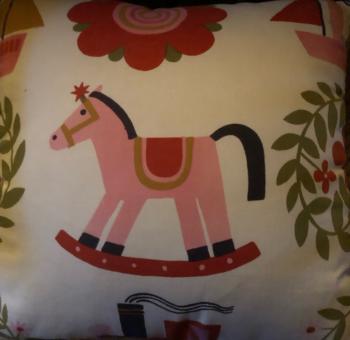
The above image is the curtain material that was in place for ‘the baby’s’ arrival.