What is Raksha Bandhan?
Raksha Bandhan, also known as Rakhi, is a beautiful annual Hindu celebration that honours the special bond between siblings. Originating from South Asia, the festival holds deep cultural and emotional significance for many families. The word Raksha translates to protection and Bandhan to bond. During the ceremony, a sister ties a sacred thread, known as a Rakhi, around her brother’s wrist as a symbol of mutual love, connection, care and a promise of looking out for one another.
Raksha Bandhan is traditionally observed each year, usually in August, following the Hindu lunar calendar. The festival holds deep cultural and emotional significance for many families. This year, Raksha Bandhan falls on Friday 28 August.
Raksha Bandhan after pregnancy and baby loss
At Sands, we understand that occasions centred around family and relationships can feel especially significant for bereaved families. For siblings, Raksha Bandhan may be a poignant reminder of a much-loved sister or brother who they are unable to celebrate with in the traditional form. For parents, it can bring thoughts of the sibling bond that their children should have shared, and the enduring love that remains beyond loss.
Sands' Forever Tied in Love campaign returned for its second year, offering families from all backgrounds, communities and faiths a way to honour and remember the sibling bond with special remembrance Rakhi bracelets. Whilst Raksha Bandhan has its roots in Hindu tradition, the love, connection and bond between siblings is something that resonates across cultures and communities. For families affected by pregnancy and baby loss, this bond continues beyond loss, and Forever Tied in Love provides a meaningful way to recognise and remember the siblings who are no longer physically with us
Each Rakhi is handmade by a member of a volunteer knitting group called Knit Your Socks Off and has two hearts entwined within the thread, one representing the sibling no longer with us, the other for the person honouring that special bond this Raksha Bandhan.
Dimple and her family remember Mannat during Raksha Bandhan
For bereaved mum Dimple, Raksha Bandhan is a poignant opportunity for her sons, Tegh and Ekam, to honour and acknowledge their sister Mannat, who was stillborn in February 2023, but remains a cherished and loved part of her family. Through the Sands Forever Tied in Love campaign, Dimple received some remembrance Rakhi bracelets this year. She said, “Rakhi now has a completely different meaning for us after Mannat. Now it represents the lifelong bond between siblings and reminds our sons that they have a sister".
Sands’ Forever Tied in Love campaign reminds families that their babies are acknowledged, they are still siblings, still part of the family and will always belong within those relationships.
Like so many bereaved families, Dimple and her husband, Gagan, have had to find their own way of navigating family occasions and cultural festivals, such as Raksha Bandhan, following pregnancy loss or the death of a baby. For their family, including Mannat is an important part of those moments. “As a family, we visit her resting place on birthdays and special occasions, and we have a special place in our home for her photographs and keepsakes. As my husband often says, our sons' continuing connection to Mannat won’t happen on its own. As parents, it’s our responsibility to keep talking about her, visiting her and helping our boys to know about their sister.
To honour Raksha Bandhan in particular, we like to tie a Rakhi at Mannat’s grave as a loving tribute from her brothers.
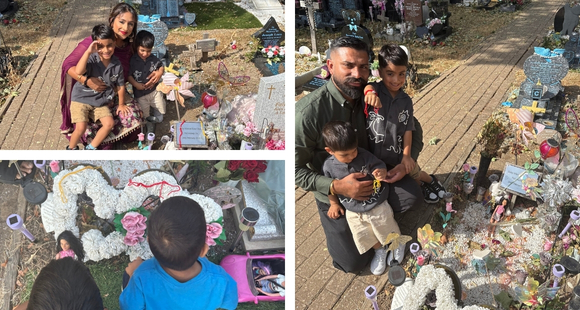
“Our eldest son, Tegh, was only two when Mannat died, so he has very few memories of her. Yet he naturally talks about her, asks questions and includes her in his drawings. If someone asks how many siblings he has, he often says, ‘and Mannat’, because to him she will always be his sister.”
Dimple continues, “Tegh will sometimes say things like, ‘I wish she hadn’t died, or why did she have to die?’. He wonders what she would be doing now or sees a toy and says it would be nice for her resting place. We also have a memory box with her clothes, teddy bears, pictures, things she touched or held, and other special keepsakes and gifts people have given us. We sometimes go through it together, which is always lovely. Whenever we make wishes, we also try to include Mannat and ask her to help us with our wish. Ekam, our youngest, is only one-and-a-half, so still too young to understand, but we still include him in these moments.”
Dimple is determined to keep speaking openly about Mannat and sharing her story so that other bereaved families feel less isolated and alone. She said, “Baby loss should never be a hidden taboo. Keeping Mannat’s memory alive is part of our everyday life. My husband named his driving school after her so that her name continues to be seen and spoken.”
Mannat's name holds a special meaning. The word "mannat" translates to heartfelt wish, or promise, and it was a name chosen by her father, Gagan, during Dimple’s pregnancy.
When her heart fell silent, her name became the truest reflection of who she would always be to us – our forever wish.
“Mannat was our second baby. We were so excited to welcome her into our family and imagined her completing it. She was like a beautiful, precious doll, ‘just sleeping and about to wake at any moment’, as my mum said when she held her. We admired every delicate eyelash, kissed her soft cheeks and memorised every tiny detail, knowing those moments with her would have to last us a lifetime. My husband still cannot forget her soft, pink hands—or the tiny flower she was holding. Every part of her was ours, and although she’s not here with us in the way we hoped, she is woven into every part of who we are.”
The response Dimple received following Mannat’s death created a mixture of emotions for her. “Our families surrounded us with love,” remembers Dimple. “People came to Mannat’s funeral, visited us, and sent flowers, cards, messages and keepsakes. Others honoured her in beautiful ways, dedicating a tree and a star to her, and we will always be grateful for that kindness.”
“At the same time, there were moments where some people avoided giving condolences for Mannat because they felt uncomfortable, while others encouraged us to move forward quickly and have more children. I’m Sikh and in our culture, loss is often something people carry silently, and people are sometimes shamed for talking about it, especially during happy occasions, but Mannat is not someone we will stop talking about. She is our daughter and always will be. We will continue to say her name because our grief does not disappear with time, and someone else’s discomfort can never compare to the loss we carry every day.”
Dimple also shared that the support her and her husband received from the NHS was incredibly important. She said, “Our bereavement midwife supported us through Mannat’s birth and continued to care for me during my third pregnancy with Ekam. The care we received made a huge difference because she already knew my background, so I didn’t have to keep repeating my history. She was incredibly empathetic and made sure I felt listened to and understood. No worry ever felt too small, especially throughout my pregnancy.”
Through sharing Mannat’s story, Dimple hopes other bereaved families will feel empowered to remember and honour their babies in ways that are meaningful to them. Whether their loss happened recently or many years ago, she believes every family should feel able to honour their baby’s place in their lives and to take part in cultural traditions. She said, “If there is one thing we would say to other bereaved families, it is this: remember your baby in whatever way feels right for you. Say their name, include them in your traditions and create your own ways of honouring them. Your baby is your child, and their life matters.”
Mannat may not be here in our arms, but every decision we make, every tradition we create and every memory we share is forever tied to her.
Sands is here to support you this Raksha Bandhan
A day woven with sacred threads, heartfelt promises and deep sibling love. For some, it’s also a day of remembrance for a sibling who is not here to give or receive a Rakhi, but whose place within the family is forever held.
If you have received one or more Rakhis as part of our Forever Tied in Love campaign this year or would like to honour and remember a much-loved sibling, we invite you to share a message on our dedication page.
Whether your loss was recent or longer ago, we want you to know that we are here for you.