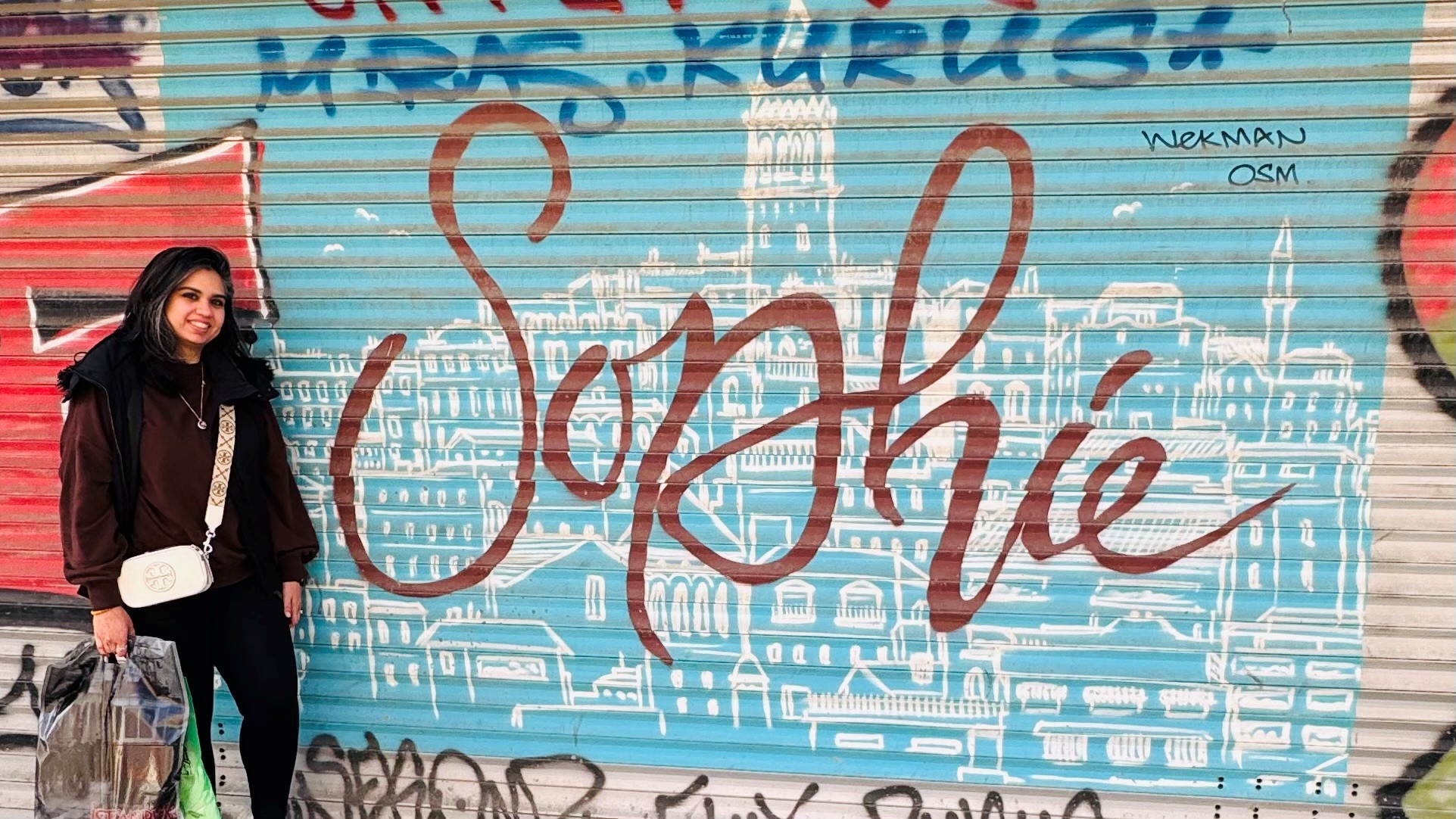
Naveen shares how her daughter Sophia, who was born early at 24 weeks and four days in May 2019 fought for five days before passing away in her parents arms. At the time she and her husband were living in Australia and had support from Red Nose, Sands' sister charity there. Since moving to the UK, Naveen attended her local Sands support group and has gone on to become a Befriender for Sands. As Sands launches the first Say Their Name Day in the UK, Naveen also shares the importance of saying Sophia's name, and speaking about her loss so other people know it's okay to talk about their grief.
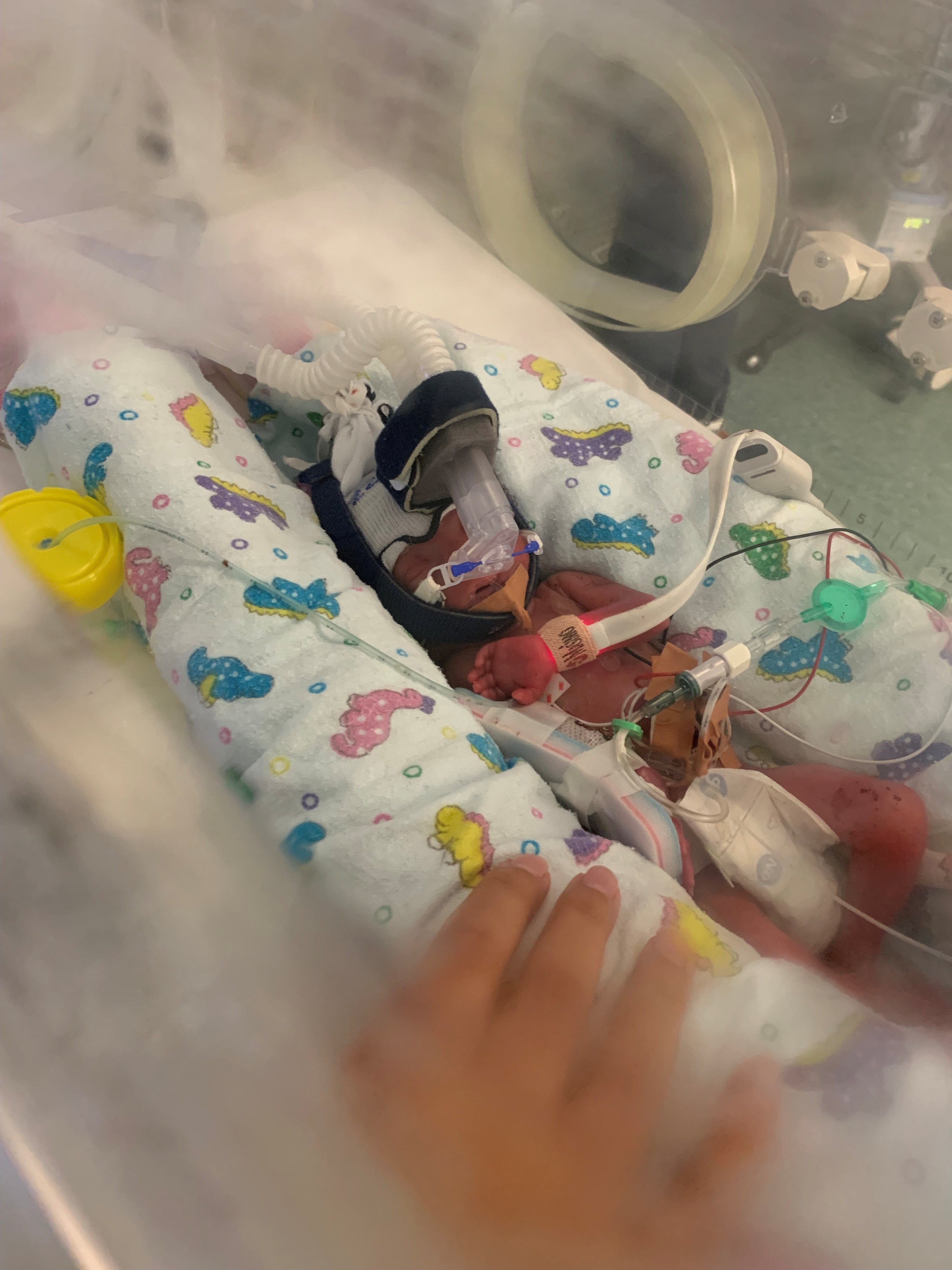
Please be aware Naveen has chosen to share a photo of baby Sophia in an incubator with her story.
Our baby girl Sophia was born early at 24 weeks and four days on the 23rd of May 2019.
I’d never seen babies in a hospital before, so seeing Sophia in the NICU was shocking, to say the least. I hadn’t expected her to have tiny arms, eyes, hair and feet. Her hands and her feet looked exactly like her fathers, and her facial features resembled my sister's first born. She was like a real, fully formed baby even at just 24 weeks.
In those five days at the hospital, whenever we sat by her in the NICU, the medical team would constantly tell us what they were doing. They were like we've got this; we'll link her up; we'll put in her tubes etc., and then they asked us, do you have a name?
At 24 weeks we had shortlisted a few, and in that moment I knew which one I wanted to keep for her, so without hesitation I said, “Yep, Sophia.” I remember the nurse taking a Sharpie and writing Sophia on her information. That was the first time that she was referred to as a real person. She wasn’t just a pre-term baby, she was Sophia.
The thought of Sophia dying didn’t cross my mind.
Even when Sophia was put on a ventilator, she was doing well initially. We remained hopeful. Her father and I took turns sitting with her, and it was a Sunday night when doctors told us she wasn’t doing well. There was air trapped in her chest but the doctor said we've put a little hole in, we released it and she was fine.
On Monday morning, around 7am my husband came to me and said, “She's not okay, we need to go downstairs.” Sophia had been disconnected from all the tubes in the NICU, and there was a little old school, nana style, quilted blanket around her.
That was the first time that we got to hold her, and we knew she was alive, looking out with one eye open. In that moment, I remember thinking, “I finally got to hold her,” nothing else registered to me. We were able to talk to her, touch her, and get some cuddles in.
A few minutes later, maybe her colour had changed, and my husband said, “Is there still a heartbeat?” That's when the doctor came in with a stethoscope and told us there was no heartbeat. At 8am on the 27th of May, Sophia passed away in our arms. It was the only time the three of us sat together as a family. She had fought for five days but was too tiny for this world.
The staff explained that we could hold Sophia for as long as we wanted.
In Islam, when someone passes away, we perform Ghusl (ritual bath). My mum is trained in this ritual and has done it countless times for the deceased of all ages in Pakistan, as well as helping their loved ones be part of the process. My mum helped perform Sophia’s Ghusl.
Little tubs and a teeny, tiny, non-scented QV soap appeared for the bath. I held Sophia and washed her. I always say that at least I got to do the mum-things of changing a diaper, giving her a shower, and holding her when she was freshly out of the bath, before they took her away from me for the first time.
Later, when they brought her back, she was cold. For me that felt uncomfortable and wrong. The medical team said we could stay overnight in the hospital, but we went home. If I were able to go back in time, I wouldn’t have left Sophia in the hospital. I would have gone to the funeral services with her. I would have watched. But I didn't know that these services were available to me. It's only after I spoke to other bereaved mums that I found out I could have gone to the funeral home to wash her again with them.
When we got to the cemetery the next day for Sophia’s burial, the undertaker gently lifted her out. He handed her to me and said, “Mama, you hold her for as long as you want to hold her.” He sat next to me, exuding nothing but kindness. In the Islamic belief, babies are born pure, so there's no judgement for them. There's no “sorrow” for the child that's passed away, because they're going to a good place. That's the fundamental belief. But as a parent whose baby has just died, you don’t want to hear that this was for the best, nor that your child is in a “better” place now. Even though in your heart, you believe it, it’s not the right time to hear those words. And the undertaker clearly knew that and didn’t offer us any of these reassurances that we weren’t ready to hear.
We had lots of support after Sophia died.
We had counselling with Red Nose, my parents came to Australia and my sister was constantly on the phone with me.
My husband’s workplace showed up for us in a way I wouldn’t have expected too. His colleagues came to Sophia’s funeral, the HR lead came over with a lasagne, and he was given parental leave and flexibility to return back to work slowly. But it was our friends who really held us together. They did everything from grocery shopping and dishes to helping us organise the funeral.
But after those initial days, I felt like I was expected to “move on” and be happy again. And for some reason that meant people stopped mentioning Sophia’s name or remembering her with me. I realised I had to continue to say her name to keep her memory alive. I reached out to another bereaved mum through a charity we volunteered with and we hit it off. Her daughter would put flowers on Sophia’s grave when they went to the cemetery to visit their little girl, and she would ask me if Sophia was her sister's best friend in Heaven. It amazed me how this little two-and-a-half-year-old was so aware of her sister in Heaven, so I started speaking up about Sophia. I’d sign her name on Eid cards, and I'd include a little yellow heart emoji because it would remind me of her. I had a necklace with her name, and a little S shaped light on our entrance table. I started saying I have no living children rather than no children and my mum very sweetly always mentions that she has four grandchildren (my sisters three and my Sophia).
There have been times when I have fallen to my knees in shock and sorrow of having a daughter who died, but Sophia wasn’t my first baby, she was my rainbow baby. My first pregnancy was ectopic; my second pregnancy was an early miscarriage and Sophia was my third.
I was pregnant again just before Sophia’s first birthday, but I ended up in the hospital with a ruptured fallopian tube due to a second ectopic pregnancy. After that, we tried three rounds of IVF, which were unsuccessful. And that was when we decided to stop.
When the Prophet Muhammad lost one of his sons, he said if the mountains could feel the grief, they would crumble to pieces with its intensity. And that is how it feels, but my faith promises that I will be reunited with my babies, that I will get to hold them again in my arms and that the emptiness of my arms is only temporary.
In February 2023, my husband and I moved to Windsor in the UK.
He had a great work opportunity, but the move was hard and I went through a very difficult and dark time when my grief came back harshly. It took me two years to feel ready to say Sophia’s name here in the UK and share her story.
I pushed myself to go to a local Sands meeting in June 2023.
I parked and stayed in my car for a good 20 minutes and then decided I couldn’t go in. At this point one of the Sands Befrienders came to the door, waved at me and asked me to come in.
I went in thinking I could just listen, but the second I walked in it was like someone was helping me carry my luggage. It all came out in hiccupping sobs and awful, foul language. And then I just felt better. The Befriender introduced me to Sands’ memorial services, the memory tree in Taplow and spoke to me about other opportunities to meet bereaved mums. I met another bereaved mum at that meeting whose daughter was named Sophie and we became instant friends.
I’m now a Befriender for Sands myself.
It feels like I’ve come full circle. I can stand in front of a newly bereaved parent and say, you will see light in the tunnel again. It won’t end, but you’ll be surprised how much stronger you will become to carry your grief forward.
Today, most days, I am able to remember Sophia with a smile or wonder what she would have been like.
Being Sophia’s mama has been my greatest adventure since the moment I got pregnant with her; it taught me to truly believe in miracles. It taught me to love bigger but also to identify boundaries and protect what I need.
It has taught me to speak up for those who are unable to speak up for themselves. To speak about my loss and my story so someone else who hasn’t been able to talk about their grief knows it's okay to talk about it. It taught me that being a mum can look different to the idea that is usually sold to people. Oddly enough, over the years it’s also taught me who can be deserving of being told my story when I meet them.
Most of all it has taught me how temporary everything is, that nothing really truly belongs to you and that even though I may not be a mum in the traditional way of ‘motherhood’, I still carry the title through my baby girl, Sophia.