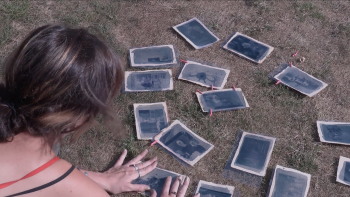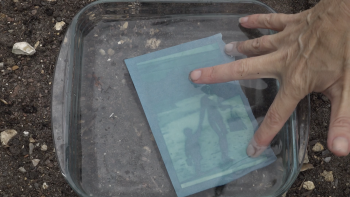
Daisy explains how when she was six, her brother William George Spurrier was stillborn. As she grew up her parents made sure William was always part of their family but last year, Daisy realised she was actively grieving her brother more than she ever had before. When it came time to make a personal film as part of her MA in Documentary course at University College London (UCL) she asked her mum if they could talk about William. From that, she spent a summer filming “Still Tracing” a documentary where her family shared and heard each other’s stories about William and their stories became one.
When I started an MA in Documentary at University College London (UCL), I thought I was making films about other people.
I fell in love with the camera almost immediately. I loved listening to people’s stories and trying to understand the world through them. But there was one thing I couldn’t quite get over. Every time someone I was filming became emotional, I’d lower the camera. I felt like I was intruding on something deeply personal.
After one particularly difficult day, a close friend said something that has stayed with me ever since.
“Daisy, I think there might be something in your past restricting you. Maybe you need to challenge yourself to be vulnerable in front of the camera to then capture that in others.”
I knew instantly what he meant.
My name is Daisy. I’m 26 years old, and when I was six, my brother William was stillborn.
Growing up, my parents were incredible at making sure William was always part of our family.
They made a memory box filled with his birth certificate, letters from friends and family, his ultrasound and the little symbols we still hold onto today - snowdrops and angels, the touchstones they gave us to remember a brother we never got to know. Every year we visited his grave and tried to mark his anniversary together.
As we got older though, life got busier. Those conversations happened less often. My parents would leave the country around his anniversary to cope, my siblings and I rarely spoke about him, and I carried my grief much more quietly. Every year, just before the snowdrops appeared, I’d feel this weight settle in my chest. It wasn’t the 13th of February itself that I struggled with most, it was the weeks leading up to it. Looking back now, I realise my body remembered before my mind did.
This time a year ago, I opened William’s memory box properly for the first time.
I couldn’t believe I’d never really looked through it before. Sitting with those objects, I realised I was actively grieving my brother more than I ever had before.
When it came time to make a personal film, I called my mum and asked if we could talk about William. It was one of the first times we’d ever spoken about him so openly. We talked about her deep sadness, the fear of forgetting, the struggle of trying to be both a wife and a mother after losing a child.
I made a short film from that conversation but instead of finding answers, I found more questions.
What had my dad experienced? What had my siblings carried all these years? What did it mean to grieve someone you never got the chance to know?
As you do, I decided to spend my summer trying to answer those questions the only way I knew how: by making a film.
As the project grew, I realised I needed support outside my family too. I reached out to Sands, and through them, I found something I hadn’t realised I’d been searching for: validation.
For years I’d questioned whether my grief really counted. Whenever I spoke about William, I often felt people didn’t quite know what to do with the fact that I was his sister.
Sometimes my loss was compared to other experiences. Sometimes people simply didn’t know what to say. Eventually I stopped talking about him.
Sands never questioned my place in William’s story.
With such kindness and sensitivity, they helped me understand that sibling grief is real. I didn’t need to compare it to anyone else’s or explain why it mattered. William was my brother, and my grief was valid simply because I loved him.
That conversation changed everything.
But even then I realised I was still hiding.
I kept pointing the camera at everyone else.
My mum. My dad. My brothers. My sister.
I was being the filmmaker. The observer. It felt much safer than putting myself in the frame.
Then one day we were filming my dad looking through William’s memory box.
He picked up a little note written in big pink handwriting.
“Dear Mum. Do you still love me? Tick here. Yes. No. Love Daisy.”
I burst into tears, I didn’t remember feeling that way. Suddenly I realised I’d spent months trying to understand everyone else’s grief whilst avoiding my own.
The missing piece of the film had been me all along.
I still wanted someone to tell me what it all meant. So, I wrote to Julia Samuel, the therapist who had supported my parents after William died. To my amazement she replied.
We started talking and as I had throughout the whole film I started telling her about my family.
Their stories. Their grief.
She stopped me.
"What about you?”
Well, I didn’t really know what to say.
I think I wanted her to answer that question for me.
I wanted to be told how long this grief would take. When would I be done with it? When would I understand it? What were the steps to make it happen?
It almost makes me laugh writing that now.
I had become so involved in documenting grief that I’d completely misunderstood it. The answer had been sitting in every story I’d filmed all along. Nineteen years on we were all still grieving William and there wasn’t an end point waiting for any of us.
Julia gave me the answers I didn’t know I needed. I was never going to be the perfect grieving sister, or daughter, or filmmaker for that matter. Grief is messy. It’s tumultuous. Losing a brother to stillbirth has been such a complicated grief to wrap my head around because, for years, I couldn’t even validate it. And when I finally did, I wanted there to be a finish line, as though understanding my grief would somehow complete it.
Instead, I realised I’d only just begun.
Looking back now I can see how losing William at six shaped the person I became.
As children, we expect our mums to go into hospital and come home with our new baby brother or sister. When that doesn’t happen it quietly changes your understanding of how life is supposed to work. You meet death long before you expect to. You watch your parents carry unimaginable sadness. Sometimes, without even realising it, you start looking for ways to make it better.
In that room with Julia, I realised I was still trying to do exactly that. Somewhere along the line I’d convinced myself this film could take the pain away. That if I made it well enough I could finally grieve “properly.”
But that was never what the film was for.
One of the last things Julia said to me changed the way I understood my family.
She pointed out that I had heard everyone’s stories, but they hadn’t heard one another’s.
We’d all been carrying our own versions of William’s story, filling in the gaps ourselves, never quite knowing what everyone else had been holding onto.
So, we sat together and listened.
It wasn’t easy, especially with my youngest brother Zam, who was born after William. We’d always been protective of him. Perhaps because his birth brought so much joy back into our family, we worried about how these conversations might affect him.
But sitting together, listening to one another with Julia present, became one of the most precious moments of making the film.
I didn’t leave with an ending that day, but we found something better: our stories became one.
This February, the snowdrops appeared, just as they always do. I found myself thinking about William, as I always will.
The difference now is that his story and mine doesn’t just live inside me anymore. It’s something I can share with my family, with other siblings, and with anyone who needs to know they aren’t grieving alone.
Looking back now, I realise I never made this film because I had the answers.
I made it because there was one story I had never truly told.
It was my story I had to tell first.
None of this would have been possible without my family, who trusted me with their stories, even when the conversations were difficult. I'm also incredibly grateful to everyone at Sands for helping me understand that my grief as a sibling was real, and to Julia Samuel, whose compassion helped my family nineteen years ago and continues to shape my understanding of grief today.
If you'd like to watch Still Tracing, the documentary that grew from this journey, it’s available to watch on Vimeo here: https://vimeo.com/1109970025?share=copy&fl=sv&fe=ci Content warning: Please be aware that Daisy's film contains discussions of stillbirth, grief and bereavement, as well as family archive footage and photographs that some viewers may find emotional.