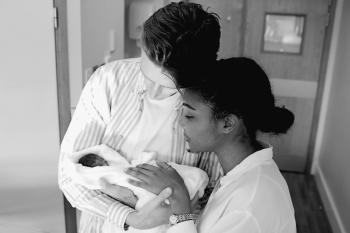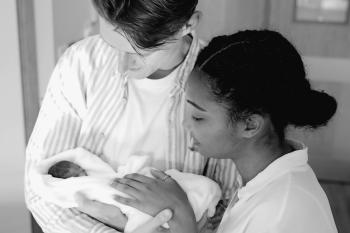
When Jenna was 24 weeks pregnant, she went into premature labour and the following day her daughter Penelope died during birth. Jenna is sharing her story as part of Black Baby Loss Awareness Week, a week that’s important to her because it feels like it gives her, and families like hers, permission to talk about their babies and openly grieve and commemorate them.
Please be aware Jenna has chosen to share pictures of her daughter Penelope with her story.
In January 2022, shortly after starting a new job, I discovered I was pregnant for the first time. It was a mixture of all the emotions you could imagine, shocked, surprised, happy and a little bit scared.
Unfortunately, I was in a lot of discomfort throughout my pregnancy. I had a painful rash that developed on my body, which spread and worsened throughout. As a generally healthy person, it was obvious that this was related to my pregnancy, but I just kept being told that doctors didn’t know the cause, and that I needed to be grateful that my baby seemed to be fine. I was miserable and in pain. I knew something was wrong, but nobody was listening.
Then when I was at 24 weeks of pregnancy I went into premature labour. The following day my daughter Penelope died during her birth.
We were moved to a bereavement suite shortly afterwards; me and my partner were able to stay with Penelope for the night. My parents and my in-laws also had the opportunity to visit the hospital and take pictures with Penelope, and I really treasure that time we all had together.
Around seven months later, I got pregnant a second time. Again, I developed the same skin rash, which then subsided; indicating to me that something was wrong. I went to the Early Pregnancy Unit (EPU) to get an early scan and found out that I’d had a missed miscarriage.
I struggled a lot with my body image after Penelope's birth and my miscarriage. I felt like my body was broken and had failed my babies by not keeping them safe. I was also left with scars and discolouration across my body from the rash that I had developed. I saw this as a sort of punishment for not being able to have a healthy pregnancy. I still struggle with this, but accessing private counselling and trying to practice yoga has helped to remind me that my mind and body are still capable of doing lots of amazing things.
I come from a mixed ethnicity household - I’m half Bajan and half white English.
I think the ‘British stiff-upper lip’ of dealing with emotions, and particularly grief is something that people can relate to not just in the UK, but across lots of former British colonies. Grief is something which is dealt with privately and then boxed away, not to be spoken of again.
I realised quite early on that I couldn't deal with my grief like this. It didn't feel fair on me and my partner, and it didn't feel fair on my daughter. I hated the thought that Penelope's name could only be said in hushed tones and had to be associated with sadness.
I grew up Christian, but now I don’t follow a religion. Therefore, it was important that my partner and I created our own rituals and traditions which felt appropriate for us to honour our daughter. For example, on Penelope’s birthday we bake cupcakes and take them to eat by her grave. We have a memory box for her, and photos and mementos of her around our house.
Now I have a son, who is almost 16 months, and I hope that as he gets older, he will create his own traditions to remember his ‘big-little’ sister.
I’ve also found a connection to nature and recognising the change of seasons, a helpful method of grounding me when I’m in the midst of a difficult period of grief. We’re lucky enough to live next to a forest and going out for even a short walk helps to boost my mood and reminds me that there is still beauty in this world, even when I’m struggling.
Shortly after Penelope’s birth, both my family and my partner's family separately brought us a ‘Penelope’ rose plant, which usually flowers around her birthday at the end of May. Having the two plants in our garden is a beautiful reminder of the presence she continues to have within our lives.
For me, Black Baby Loss Awareness Week is so important.
I feel like it gives me and families like mine permission to talk about our babies and openly grieve and commemorate them. Even if you're not ready to talk about your own experience, it's just letting people know you're not alone, we exist and our babies matter.
I didn’t realise until it happened to Penelope that Black babies and babies of mixed ethnic backgrounds are more likely to be stillborn or die during the neonatal period.
Black Baby Loss Awareness Week puts a face to those statistics and amplifies our voices so that together, we can create change. We're not just numbers, and we shouldn't just have to accept that our babies die at higher rates in pregnancy or childbirth because of their ethnicity.
A lot of things happened after Penelope's birth and my following pregnancies which I'm still very angry about. I was let down a lot by healthcare professionals, and it felt like I wasn't given the compassion and support that I should have been when I needed it the most. A lot of assumptions were made about me, and the care I received because of my ethnicity.
Black and mixed ethnic families shouldn’t have to deal with microaggressions and prejudices whilst also navigating grief. It only exacerbates our trauma. I am now very distrusting of medical professionals and the information that they give me. This particularly affected me in my last pregnancy.
I was first introduced to Sands when I was given one of their bereavement support books whilst I was in hospital.
Since then, I’ve been on a journey and found a lot of strength in speaking with other bereaved parents. At first through the Sands Online Community reading other people’s experiences of how they dealt with life after loss. And as time has gone on, I've felt more comfortable talking about my grief and was lucky enough to attend an in-person event with mothers and stakeholders within African, Caribbean and South Asian communities.
It’s rare to be in spaces outside of my immediate family where I can honour my daughter, enjoy myself and have a laugh. There is a level of commonality with other bereaved parents. However, there isn’t only one way of experiencing baby loss in the African and Caribbean community. I really appreciated hearing the diversity of experiences and what others have created since their bereavement.
Being a bereaved parent can be a lonely place at times. I still have my difficult days where it can feel like the weight of grief is all-consuming, but there are still opportunities for joy, fun, and laughter, and your babies can continue to be part of these happy moments as well.
After the safe birth of my son at the end of 2024, I decided that I wanted to give back to Sands and help contribute to raising awareness of their work within hospitals.
During my last pregnancy, it was very clear that a lot of healthcare professionals still didn’t know how to appropriately discuss pregnancy or baby loss and didn’t know how to support parents who are pregnant after a loss.
So, I have recently started volunteering with Sands as a Hospital Liaison Volunteer in the hospital where I gave birth to my son. I’m still relatively new to the role, but I have already met with the bereavement team in the hospital and will be arranging regular check-ins to make sure they have enough support materials from Sands. I will also be updating them on local support services and groups that are available for bereaved parents to access in the community.
I hope that by providing greater awareness of Sands’ services, I can support more bereaved parents to feel less alone after pregnancy loss or the death of their baby. I remember feeling very isolated after the death of my daughter, the usual places and people that I would turn to for support were not providing me with the help that I needed at the time. I hope I can help to increase the visibility of Sands and their work to healthcare professionals and in-turn to bereaved parents. Even if this is only in one hospital, I’m aware that even small interventions can make a big difference to a family in their time of need.