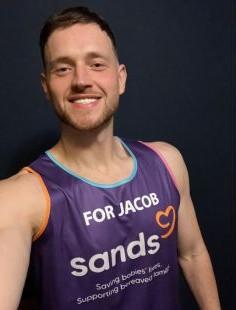
When his son Jacob was stillborn in 2015, Jordan remembers feeling very, very lonely, but attending a Sands group in Nottingham changed that for him. 10 years on, Jordan celebrates Jacob and recalls the things that were most helpful to him, including people saying Jacob's name, following his loss. He also shares how running the London and Berlin Marathons this year is one of the ways he expresses his love for Jacob and how running for Sands and representing a community of people who have gone through pregnancy and baby loss feels really special for him.
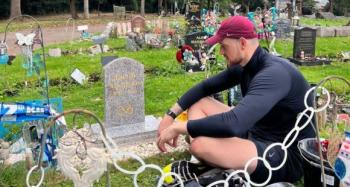
Please be aware Jordan has chosen to share a picture of Jacob’s grave with his story.
Jacob was a very long baby. He was born around 34 weeks, and had a head full of dark hair. He had big hands and big feet, he would have been tall, and beautiful little lips. He was exactly what I imagined he would look like.
I remember after Jacob died that I needed to do something practical
As a father, when Jacob was on the way I was prepping myself to do practical things when he arrived. When he died that was taken away, but I still had that energy and very much felt that need to be practical. For me that meant tending to his grave and getting his funeral booked, and over the last 10 years, my relationship with Jacob has always stayed very practical. For example, I’d visit his grave once a week, clean it, lay his flowers down and talk to him but during this last year, that’s really changed.
Following a headstone run I did for Jacob, there’s been a monumental shift in my life
For the first nine years after Jacob died, I carried a lot of pain around. I was easily hurt and I felt like I had to go and visit Jacob’s grave to have a conversation with him because that’s where he was, at the cemetery in his grave in the ground.
When I did the stone carry I spoke to Jacob the whole way. At the end of the run when I arrived at his graveside, I thought I would be really emotional, but I felt completely at peace for once because I had this realisation that Jacob had been with me the whole time I was running from Scotland to Nottingham. Now I very much carry Jacob around with me. He's in the work that I do, he's in nature and he's in the conversations that I have. Today my relationship with him is less hurt and more love. Today I carry him in my heart and that has been a huge, transformative shift. I’m in such a good place now and less hurt, more love is something I wish I'd found sooner because I went through a lot of pain.
Today I don’t even visit Jacob’s grave. Before I struggled with a lot of guilt if I didn’t visit and I used to call his grave the centre of my universe because that’s where I felt he was, but I had a really unhealthy relationship with visiting him there because it hurt me a lot. At the start, it was an amazing way to process my grief but over time, I got stuck in a situation of having to go there every single week, and if I didn’t feeling guilty and feeling like Jacob was watching me thinking I'm a bad dad.
I met a church pastor a couple of years ago and I remember saying to him it's okay that I feel so much pain for Jacob, because the reason that I feel that is because I loved him so much, and the pastor said I don't want to disagree with you, but I think the reason that you’re hurting so much is because you're not willing to let go. Straight away I said, I can’t let go of Jacob, and he said, it's not about letting go of Jacob. It's about being able to let go of the pain. He was so right. It was like I was addicted to my grief and the feeling of being hurt because I felt if I wasn’t in pain then it meant I didn’t love Jacob. Going to his grave and making myself feel that pain was a sign of how much I loved him. The pastor said it would be really beautiful for me and Jacob if I could get myself to a place that didn't feel painful because then my beautiful feelings for Jacob would start to flourish and I’d feel better. Again, he was so right.
Today, my family and I celebrate Jacob. I’ve got a tattoo on my hand that says for Jacob and we get together as a family for his birthday, which makes me so happy. We have dinner, and we sometimes get balloons and a birthday cake, and it's a big celebration. That’s really nice not only for me but for my whole family.
Stillbirth is difficult because it's taboo
People don't want to talk about it. They don't want to talk about your baby. They don't want to say their name. They're scared. People think, what do I say and how do I say it? so they’d rather not talk about it but as a parent, it’s sad because you grieve losing your baby, but you also grieve the ability to talk about and to honour them.
I remember thinking that a lot after Jacob died. I could tell when people didn't want to say his name and if I said his name, it'd take the energy out of the room. I remember so many situations where people would leave the room if I said anything about Jacob but talking about him is really important to me. Not being able to do that over the years is a burden that I’ve carried that people can’t see. It’s a shame that as a society we’re still so far off from talking about pregnancy and baby loss openly.
I’m very blessed that my family had conversations about Jacob with me
My mum experienced stillbirth herself. My older brother Jason was stillborn, so when Jacob died, mum had the ability to talk to me without fear and with understanding. Mum was there for me from the moment it happened in the hospital all the way through. She even had a full circle moment with Jacob because when Jason was stillborn, she didn’t hold him, and she’s since told me that it’s the only life regret she has. It really hurt her that she didn't hold Jason so the most beautiful moment for her was being able to hold Jacob. She told me make sure you hold him and make sure you spend time with him. That was huge for me and for my mum.
I had very isolated moments when mum wasn't around and it was tough. In particular, I found people saying ‘life goes on’ very difficult to swallow because although I’m sure it was said with good intentions, it felt very forceful. I went straight back to work after Jacob died and one of the owners had lost their baby as well. He didn't want to talk about his baby, and he was very much in a mindset of telling me ‘You’ve just got to move on. We don't talk about it. We’re men, we’re stoic, we move forward’, and I remember feeling super isolated by that because it set the tone for everybody else. A lot of my friends did the same thing.
I think the difficulty is you've been gearing up for months for this happy moment and your community around you is ready to wish you well and congratulate you on the arrival of your baby, so when that doesn’t happen, you have to deal with awkward interactions.
I’ll always remember the people who spoke about what had happened, who put their neck on the line and said, I heard what happened. I'm so sorry. Is there anything I can do?
Or the people who didn't say anything but just text me and said, Jordan, I dropped some food off at your porch, if you want to chat, we can chat.
Anyone who spoke or interacted with me at that time never said anything wrong because what mattered was that we were having a conversation, and I could see they were trying, and I only ever felt supported by that. The people I struggled with were the people who tried to tell me to forcefully move on, like my friends who got upset because I couldn’t face people and join a birthday night out the day before Jacob’s funeral. Those kinds of things were tough to deal with.
If you want to help bereaved parents, say their baby’s name
Whenever someone said Jacob’s name it filled me with so much happiness even in really hard moments. Avoiding saying a baby’s name is hurtful, and it's really joyful for bereaved parents to hear their baby’s name, so be brave enough to say it.
Also, don’t be afraid to go and help parents without asking for permission. It’s possible they’ll tell you to go away and leave them alone, and that's their embarrassment, but that's the price you pay for trying to help somebody you care for. For me, if you care about somebody it's worth paying that price.
The biggest things that helped me were people bringing food round and helping me practically because after Jacob died, I lost everything in terms of my practical ability. I wasn't eating or looking after myself so when people dropped off some food it meant I could function again for an hour. It saved me in that situation. If someone had asked me though, do you mind if I drop you off some food? I'd have said it's fine, don't worry about it, so don't give someone the opportunity to say no, just go and help them.
Another thing that really helped was when my mum came and cleaned my house. She knocked on the door, put some rubber gloves on, and said you can go upstairs then she cleaned the whole house. I remember how big that felt at the time because I was just so lost. Having people clean the house, do washing and bring food around was unbelievable.
As a grieving father I remember feeling very, very lonely
In the first two weeks after Jacob died, I couldn't feel anything. I was upset initially then a couple of days later I just went completely numb to the world. I couldn’t even cry. I thought oh gosh, I'm broken, something's wrong with me. It felt suffocating not to be able to feel any emotion so I was googling to try and figure out what was wrong with me, but I couldn’t find anything about it.
It was attending a Sands group in Nottingham that changed that for me. At the group I explained how I was feeling and another dad told me that he’d felt the same way for two years after losing his baby. Learning that he'd gone through the same thing must have unlocked something for me because while I was driving home that night my grief hit me again. It was like day one of losing Jacob and I was crying so much that I had to pull my car over. I think knowing that there was somebody else out there who had been through the same feelings as I had took away my anger and frustration and the feeling that I was the only dad who knew what this was like. That sharing unlocked everything and I started to be able to grieve again, so the support from Sands had a hugely positive impact on me.
To other grieving dads I’d say try and find a space that feels good for you where you can connect and honour your baby. It could be during your dog walk, it could be picking flowers for them, cooking or doing something physical like surfing or running a marathon.
For me doing physical challenges in honour of Jacob are massive and one of the ways I express my love for him
That’s why I’m doing the London and Berlin Marathons this year. London will be my first official marathon which is exciting.
I’m training hard for them, and that’s helping open up conversations with people about Jacob too. As a grieving parent of a stillborn baby, you're almost coerced or taught to avoid talking about them and bringing their name up in day-to-day life, so running in their name is the total opposite of that, and that’s very important. For me to be able to say Jacob’s name loudly and proudly and for other people to be able to see it on my running vest, is really, really special. I absolutely love wearing Jacob’s name. When I run with his name on me it almost feels like a bit of a superhero cape and like he’s giving me power, strength and a bit of help.
Running the London and Berlin Marathons for Sands also feels special because it feels like I’m running for and representing a community of people who have gone through stillbirth, pregnancy and baby loss
That’s a huge shift for me because before I was very caught up in my own emotions and feelings, but these marathons feel like I’m flying the flag for stillbirth, for Sands and for pregnancy and baby loss awareness, sharing how widespread it is and how it impacts so many people.
Supporting Sands is important because the charity is a big part of helping people to be able to get through their loss and to breathe and live on the other side, and we need to support them so they can have the biggest impact possible and help more people get over to the other side of their loss.
Baby loss should be a huge conversation, it should be current, it should be frequent and it shouldn't be a special thing that we talk about during an awareness week once a year. The fact that it's still taboo to talk about baby loss has got to change. We’ve got to shake that up, so the voices that are talking about it and the people who are running, raising money or supporting Sands matter.